 Block
After the Binance Hack: How to Spot Fake Compensation and "Priority Withdrawal" Scams
On October 29, thieves pulled roughly $6.3 billion out of Binance, the world's biggest crypto exchange. It's the largest crypto theft on record, about four times the size of the Bybit hack in early 2025. Withdrawals were frozen, and millions of people were left wondering whether their money was safe.
That worry is exactly what scammers feed on. Within days, fake "compensation" offers and paid "priority withdrawal" deals were showing up everywhere. Binance has warned about a possible second wave of theft, this time aimed straight at its users. If you use Binance, or any exchange, here's how to spot these Binance hack scams before they cost you.
What Happened at Binance (the Short Version)
The attackers went after Binance's hot wallets, the online wallets an exchange uses to process everyday withdrawals. According to blockchain analytics firm TRM Labs, most of the money left in about 20 minutes, across ten different blockchains. TRM links the attack with high confidence to a North Korean hacking group the FBI previously tied to the Bybit hack. Binance hasn't published a full explanation of how the hackers got in. Its early investigation pointed to a compromised engineer's laptop, and a later update mentioned "additional points of breach."
The good news for customers: Binance says it will absorb the loss, "not our users." As of October 31 it said it had already covered 90% of the stolen assets and pledged to cover the rest. Around $3 billion of the stolen funds has also been frozen with help from stablecoin issuers and law enforcement. Withdrawals began reopening in phases on November 1.
The Binance Hack Scams Making the Rounds
The hack itself is Binance's problem. The scams that follow it are yours. Here's what Binance and its leadership have publicly warned about:
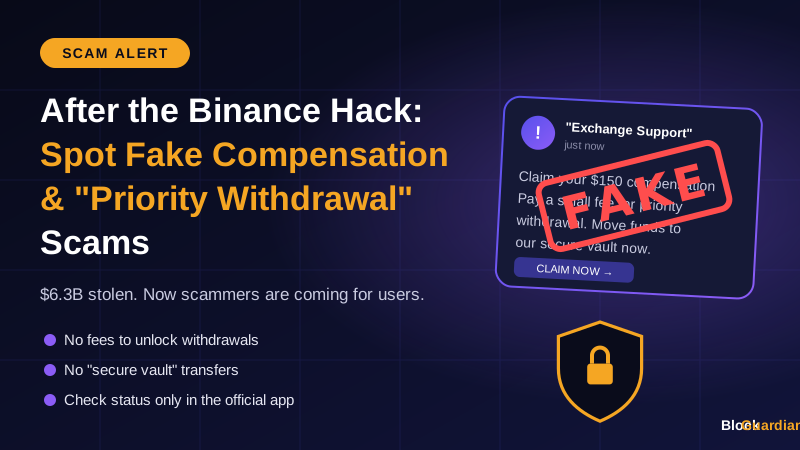
- Fake compensation payouts. Screenshots promising users $150 for the withdrawal freeze spread on social media, along with links to a "rewards hub." Binance co-founder Yi He said there is no cash voucher campaign. Another Binance executive said users won't be compensated for the pause at all.
- "Priority withdrawal" for a fee. Someone offers to move you to the front of the withdrawal line, for a price. Binance says plainly that anyone offering to speed up withdrawals for a fee is a scammer.
- "Move your funds to a secure vault." A fake support agent says your account is at risk and you need to transfer everything to a safe "Binance vault." There is no such thing. That wallet belongs to the scammer.
- Fake claim and reserve websites. Look-alike sites for "compensation eligibility" checks or fake proof-of-reserves pages, built to steal your login or get you to connect your wallet.
- Malicious wallet approvals. You're asked to "authorize" a transaction to regain access to your funds. Approve the wrong thing, and the attacker can drain your wallet without asking again.
These pitches arrive by email, text, direct message, Telegram or Discord group chats, and even tiny crypto deposits with a message attached. If that "move your funds now" script sounds familiar, it's the same playbook we broke down in our post on fake crypto support scams. The headline just changed.
Three Rules That Shut These Scams Down
- Real exchanges never charge you to get your own money. Binance says it doesn't charge fees to unlock withdrawals and doesn't sell recovery services. Any "fee," "tax," or "unlock charge" is the scam.
- Check status only inside the official app. Don't click links in messages. Open the app or type the website address yourself to see where your withdrawal stands. If a message claims to be from Binance, check it with Binance's official verification tool, Binance Verify, inside the app or on its real site.
- Never approve, sign, or share to "regain access." Binance says it doesn't ask customers to authorize wallet transactions to get their funds back. No legitimate company will ever ask for your password, 2FA code, or recovery phrase.
Not on Binance? This Still Applies to You
Every major hack or outage brings the same wave of fake refunds, fake recovery agents, and fake "secure wallets," whichever company is in the news. Binance founder Changpeng Zhao also warned this week that AI is speeding up cyberattacks, which means scam messages are only going to look more polished and more convincing.
This is also a good moment to think about how much you keep on any exchange. An exchange holds your crypto for you, and even the biggest one can be hacked or freeze withdrawals. Many people keep only what they actively use on an exchange and hold the rest in a wallet they control. Whatever you decide, know where your crypto is and who holds the keys.
The Takeaway: Slow Down When the Headlines Get Loud
Binance hack scams work because people are scared and in a hurry. So do the opposite. Get your information only from the exchange's official app and official accounts. Treat every unexpected message about compensation, faster withdrawals, or "securing" your funds as a scam until proven otherwise. And remember the simplest rule of all: if someone wants you to pay, sign, or move your crypto to fix a problem, the problem is them.
Sources: TRM Labs · Graphic Online · Cointelegraph · CryptoSlate · Blockonomi · Bitcoin.com News
📩 Stay Ahead of the Next Scam
Get breakdowns like this one — free, straight to your inbox, whenever a new scam or safety risk shows up. No spam, unsubscribe anytime.
#CryptoSecurity #BinanceHack #CryptoScams #ScamAlert #PhishingScam #ImpersonationScam #ExchangeSecurity #SelfCustody #CryptoSafety #CryptoEducation #BlockGuardian
⚠️ Disclaimer: This content is for educational and entertainment purposes only and does not constitute financial, investment, legal, or tax advice. If you believe you are the victim of a scam, contact your local law enforcement and file a report at ic3.gov. Always do your own research before making any financial decisions.