 Block
Block 
Legacy Planning
If Something Happened to You Tomorrow, Could Your Family Find Your Crypto?
We spend a lot of time on this blog talking about keeping scammers out of your crypto. This week is about the opposite problem, and it's one almost nobody plans for: making sure the right people can get in when you can't. Self-custody is the safest way to hold crypto, and it has a catch. No bank has a copy of your keys, no customer service line can reset them, and no court order can make the blockchain hand your coins to your spouse. If the only map to your crypto lives in your head, it can disappear with you.
The Cautionary Tale Everyone in Crypto Knows
In late 2018, Gerald Cotten, the founder of the Canadian exchange QuadrigaCX, died suddenly while traveling in India. In early 2019 the exchange told the world it couldn't reach roughly $190 million (US) in customer funds, because Cotten had been the only person with access to its cold storage wallets. Later investigations found the story was messier than lost passwords, but the headline stuck for a reason: one person held all the keys, and nobody else had a plan. Most of us aren't running an exchange. The same thing happens quietly in ordinary families, though, one hardware wallet in a desk drawer at a time.
What Your Family Is Actually Up Against
Picture your spouse, your kids, or your executor sitting at your kitchen table a few weeks after the worst has happened. Here's what they're likely facing:
They don't know what exists. Which exchanges did you use? Is there a hardware wallet? A phone wallet? Coins on an old laptop? If nobody knows an account exists, nobody goes looking for it.
They can't tell a device from a paperweight. A hardware wallet with no PIN and no recovery phrase alongside it is a small plastic brick. Guess the PIN wrong too many times and many devices wipe themselves.
The exchanges want paperwork. Custodial accounts can usually be recovered by an estate, but it means death certificates, legal documents, and weeks or months of back-and-forth. That only works if someone knows the account is there in the first place.
Scammers watch for grieving families. "Crypto recovery services" target exactly this situation, promising to unlock a lost wallet for an upfront fee. A grieving family with no plan and no crypto background is the easiest target there is.
A Simple Crypto Legacy Plan in Five Steps
You don't need to be wealthy or a tech expert to fix this. You need an afternoon and a pen.
1. Make a complete inventory. List every exchange account, every wallet (hardware and software), and roughly what's in each. Include the boring stuff too: the email address tied to each account and whether 2FA is on it.
2. Write down where things are, in plain English. "The Ledger is in the fire safe in the basement closet" is worth more to your family than any technical explanation. Assume the person reading it has never bought crypto in their life.
3. Decide how your recovery phrases will be passed on, and keep them offline. Never in an email, a cloud document, a phone photo, or a password-protected PDF on your desktop. Paper or metal, stored somewhere physically secure, such as a home safe or a safe deposit box your executor can get into. Treat the finished plan with the same care as the crypto itself, because anyone who holds it can take the funds.
4. Tell one trusted person the plan exists. They don't need the details today, just that a plan exists and where to find it. A perfect plan nobody knows about helps no one.
5. Talk to an estate attorney, and update the plan once a year. Crypto belongs in your will or trust like any other asset, and a professional can make sure your wishes hold up legally. Then pick a date, like your birthday or tax day, to review your inventory, since accounts get opened, closed, and moved over the years.
📚 From the Author · Our Best Seller
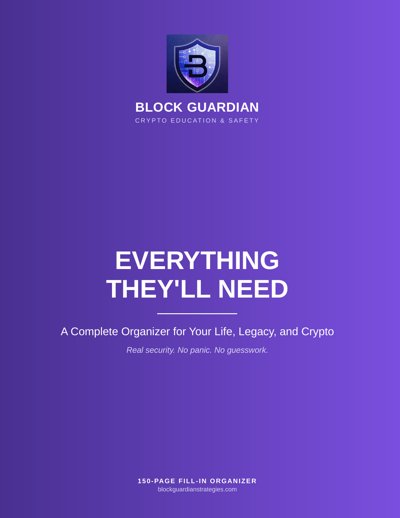
Everything They'll Need: A Complete Organizer for Your Life, Legacy, and Crypto
We wrote this book for exactly this problem. It's a 150-page, 8.5×11 fill-in organizer that walks you through the whole plan above, then gives your family a map they can follow:
- Part 1, Protect It While You're Here: passwords, 2FA, hot vs. cold storage, and the seed phrase rules.
- Part 2, The Complete Organizer: 21 fill-in sections, from bank accounts and insurance to a full Cryptocurrency & Digital Asset Legacy section (exchanges, wallets, where your seed phrase backup lives, and a plain-English walkthrough for a non-crypto heir).
- Part 3, Protect Your Family After You're Gone: the scams that target grieving families, a safe first-30-days checklist, and how to access crypto without getting scammed.
Built-in safety rule: the book never asks you to write your seed phrase in it, only where it's stored.
Get It on Amazon →The Takeaway
Owning your keys is the right call, and it means you're also responsible for what happens to them. A few hours of planning now is the difference between your family inheriting your crypto and your crypto sitting untouched on the blockchain forever. Make the inventory, write down where things are, store the sensitive parts offline, and tell one person the plan exists. It's one of the most practical things you can do for the people you love.
#CryptoInheritance #EstatePlanning #CryptoSafety #SelfCustody #SeedPhrase #HardwareWallet #LegacyPlanning #CryptoEducation #StaySafeCrypto #BlockGuardian
📩 Stay Ahead of the Next Scam
Get breakdowns like this one — free, straight to your inbox, whenever a new scam or safety risk shows up. No spam, unsubscribe anytime.
⚠️ Disclaimer: This content is for educational and entertainment purposes only and does not constitute financial, investment, legal, or tax advice. For estate planning, consult a qualified attorney in your state. Always do your own research before making any financial decisions.